Computer Simulation
Systems & Layout Modeling
I am fascinated by modeling complex systems, from continuous differential dynamics to discrete-event simulation and parallel GPU computing.
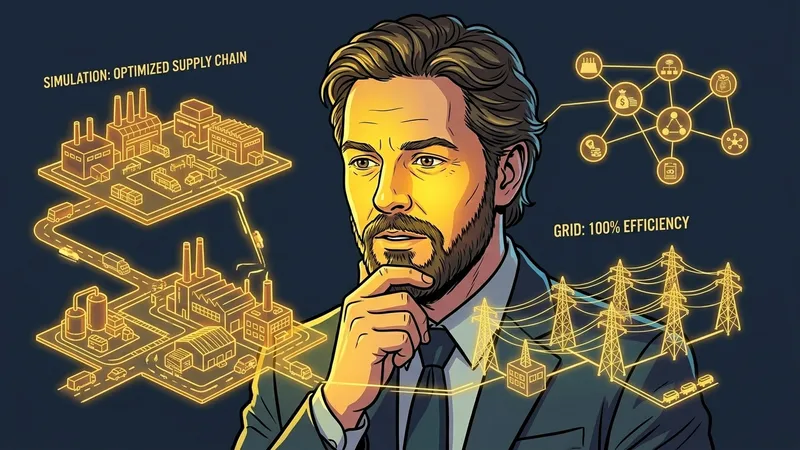
Why This Field Excites Me
Personal motivations, core engineering philosophy, and architectural principles driving my work.
Computer simulation is nothing short of a computational time machine. It grants us the extraordinary ability to construct virtual laboratories, observe emergent non-linear dynamics, and rigorously evaluate millions of design scenarios—long before committing physical capital, building factory lines, or deploying mission-critical infrastructure.
1. Mathematical Foundations: Continuous & Discrete-Time Dynamics
At the heart of simulation lies the balance between static models (which capture structural relations, geometric footprints, and equilibrium states) and dynamic models (which trace how systems evolve over time).
Physical processes—such as fluid flow, thermodynamics, and mechanical motion—operate under continuous-time dynamics governed by systems of non-linear differential equations (). Solving these systems requires advanced numerical integration algorithms (such as 4th-order Runge-Kutta or symplectic solvers) to compute trajectory approximations with tight error bounds.
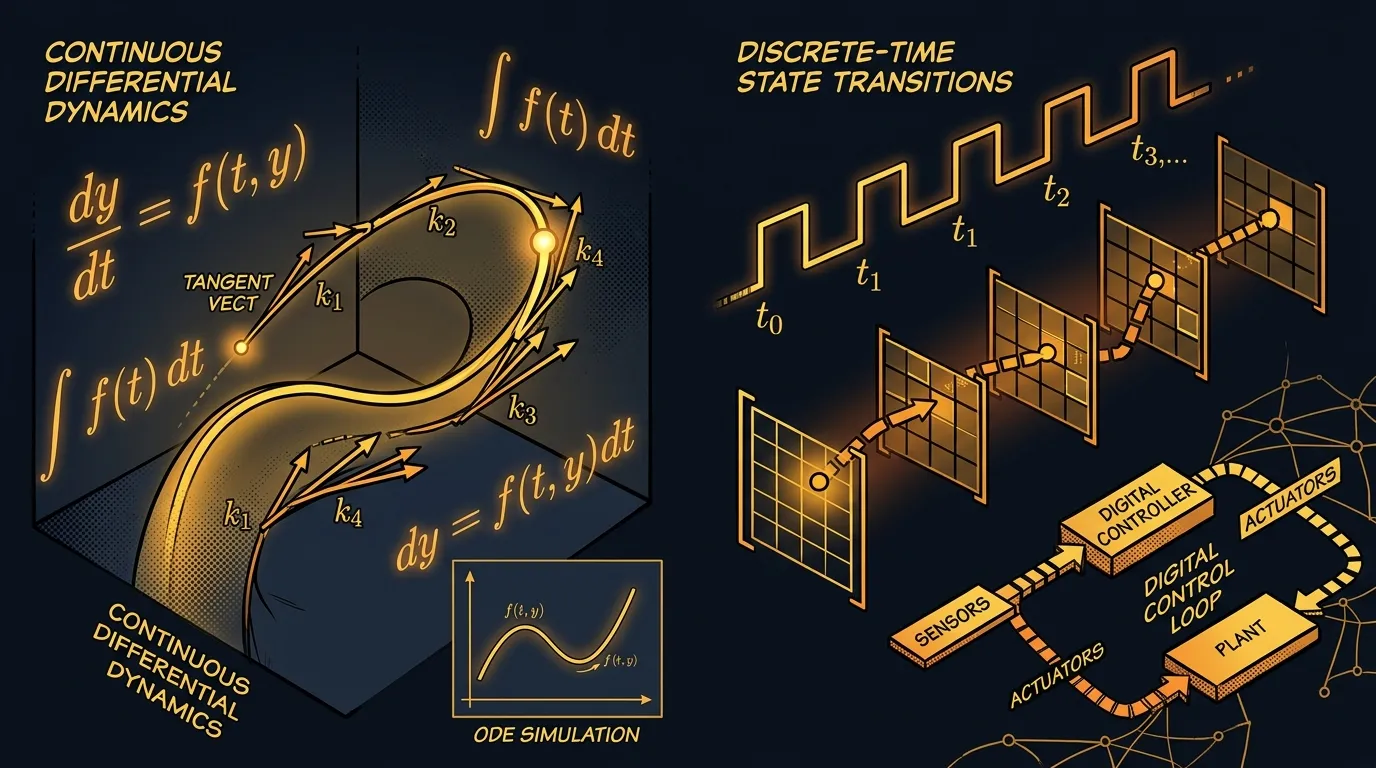 Figure 1: Continuous-time differential dynamics solved via 4th-Order Runge-Kutta (RK4) numerical integration alongside discrete-time state transition dynamics.
In contrast, cyber-physical controllers, digital logic, and sampled-data systems operate under discrete-time dynamics (). Simulating modern industrial systems requires harmonizing continuous physical plant dynamics with discrete digital control loops in unified simulation environments.
2. Managing Uncertainty: Discrete-Event & Monte Carlo Methods
Industrial manufacturing, supply chains, and transportation networks are inherently asynchronous, queue-based, and stochastic.
In Discrete-Event Simulation (DES), state variables do not change smoothly with continuous time; instead, they transition instantaneously at discrete points where events occur (e.g., a part arrives at a buffer, a machine completes a weld, or an automated guided vehicle changes tracks). By maintaining an efficient Future Event List (FEL) priority queue, DES allows us to simulate months of factory operations, evaluate specialized layout topologies (such as spine layouts), and identify subtle bottleneck propagations in just seconds of compute time.
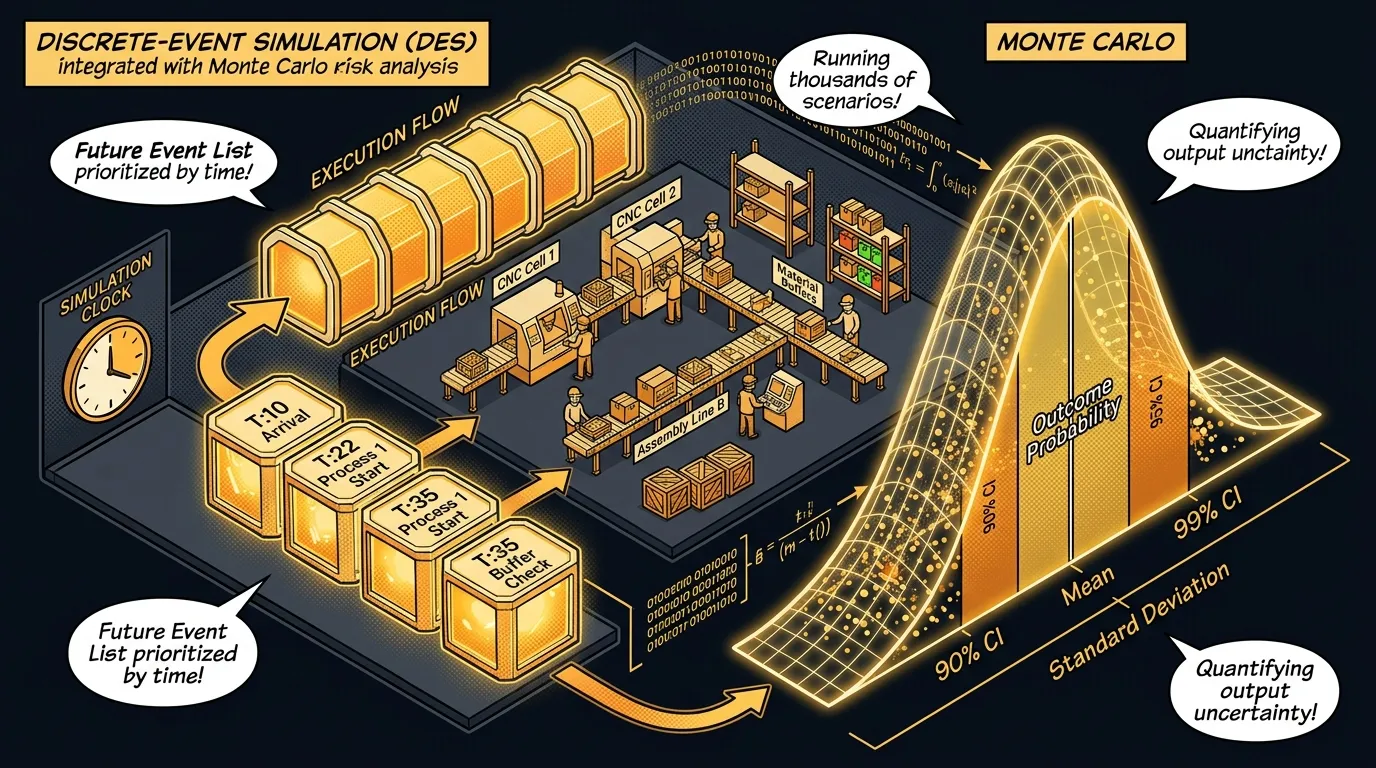 Figure 2: Discrete-Event Simulation (DES) engine with Future Event List scheduling and Monte Carlo statistical distribution analysis.
To evaluate risk and operational resilience under real-world variability (e.g., stochastic machine breakdowns or fluctuating customer demand), we deploy Monte Carlo simulation. By running tens of thousands of randomized runs across parametric probability distributions, we derive statistical confidence intervals, uncover black-swan edge cases, and design robust operating policies.
3. High-Performance Compute & Real-Time 2D/3D Graphics
Modern simulation models demand immense computational horsepower. Simulating large-scale logistics networks or high-fidelity physical phenomena pushes beyond single-threaded CPU limits.
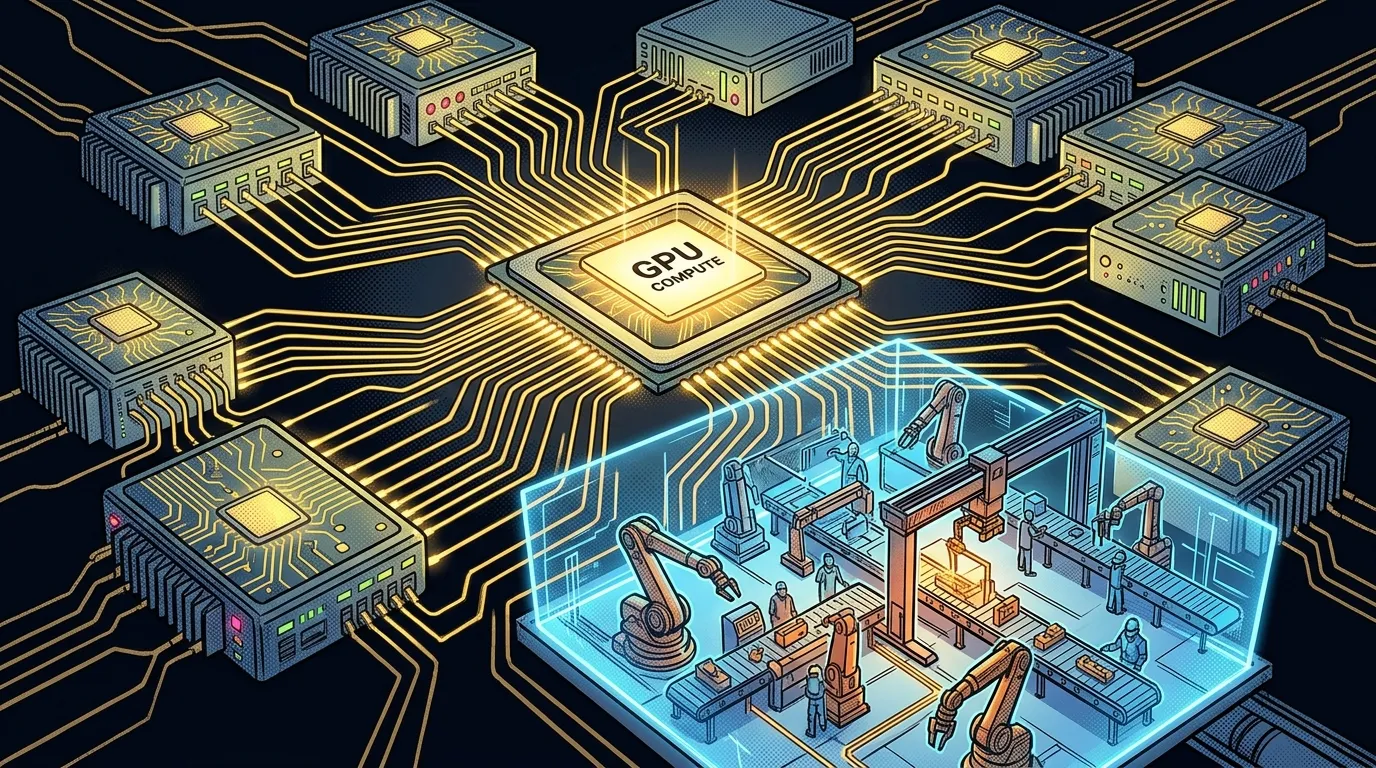 Figure 3: Massive parallel compute architecture leveraging GPU shaders, multi-threaded CPU worker pools, cluster nodes, and real-time 2D/3D visual rendering.
We harness high-performance computing paradigms across every layer:
- Multi-Threading: Distributing independent entity calculations and physics solvers across multicore CPUs via lock-free worker pools.
- Cluster Programming: Partitioning massive parameter sweeps and distributed Monte Carlo batches across compute clusters.
- GPU Programming (WebGPU / CUDA): Massively parallel compute shaders simulate millions of interacting agents and particle dynamics simultaneously.
- 2D & 3D Computer Graphics: Rendering dynamic simulation states in real-time WebGL viewports (such as in Delta Dynamics and SpineML) provides engineers and stakeholders with immediate visual intuition, transforming raw mathematical telemetry into clear, explorable insights.
Explore Other Personal Interests
Interested in Computer Simulation?
Whether you are working on innovative software architectures, simulation models, AI workflows, or interactive user experiences—let's connect and exchange ideas.