PublicationNov 1, 2016
The TRANSP-0 framework for integrated transportation and power system design
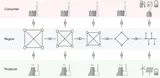
Increasing penetration of decentralized energy production as well as the propagation of new transportation paradigms such as transportation electrification, autonomous vehicles and mobility-on-demand will require interrelated key changes to current transportation and power systems. To diminish negative environmental impacts and achieve longterm sustainability, close integration between transportation and power systems is necessary and integrated planning, operation and control strategies have to be established. In this paper, we present TRANSP-0, a system design framework for rapid formulation and evaluation of design options within integrated transportation and power systems. Firstly, we present the TRANSP-0 design space in terms of the static parameters for integrated subsystem design. Secondly, we visit the dynamic properties of subsystem design by formulating the underlying optimal control problem. Thirdly, we establish the requirements to integrated control strategies in terms of objectives and constraints of the described optimal control problem. Finally, we conclude with an outlook on the future scope of the proposed system design framework.
PublicationJun 26, 2017
The passenger extension of the TRANSP-0 system design framework
In recent years, potentially disruptive transportation paradigms such as mobility-on-demand, autonomous vehicles and the transportation electrification have seen increased attention for designing intelligent transportation systems (ITS). These paradigms represent unifying approaches in addressing sustainable alignment between transportation demand and supply in the context of rising world passenger transport energy use and increasing negative environmental impacts. It is crucial to establish integrated planning and control strategies for both transportation and power systems, as the aforementioned paradigms exert interrelated and concurrent effects on these systems. To evaluate future transportation and power system design options coherently and explore the potential effects of the aforementioned paradigms, in this work, we extend the design space of a formal system design framework for integrated …
PublicationNov 11, 2014
Early Estimation of Multi-Objective Traffic Flow
Intelligent Transportation Systems (ITS) have come a long way targeting problems such as increasing emissions and growing vehicle numbers. Current approaches address a variety of objectives including congestion management, collision avoidance, energy-efficiency and emission reduction. However, respective solutions typically are designed for and tailored to a predefined set of objectives. Consequently, the effects of drastically changing objectives cannot be assessed easily. To address this situation we present a lightweight approach to estimating multi-objective traffic flow early in systems engineering using non-deterministic models and stochastic optimization techniques. We demonstrate the feasibility of the framework using a basic traffic scenario and conclude with future work.
PublicationFeb 26, 2025
Next-Generation Design Tools for Intelligent Transportation Systems.
Intelligent Transportation Systems (ITS) promote new transportation paradigms such as connected and autonomous vehicles (CAV), multi-modal and demand-responsive transport systems, and enable the transportation electrification by sustainable operation of electric vehicles. Methods and tools are needed to explore the possible design space for emerging transportation paradigms, which support evaluation of system design alternatives and verification of system properties. In this work, we propose a model-and simulation-based systems engineering framework for capturing design decisions and evaluating control strategies for ITS design. In addition to capturing and evaluating different design decisions, the proposed solution allows users to guide design decisions by systematic comparison and evaluation of system configurations and control strategies.
PostOct 1, 2015
Integrated transportation and power systems modeling
Here is another interesting piece of work I was doing over the past three years with Dominik Ascher: Integrated transportation and power systems modeling to hel...
PublicationOct 1, 2014
Towards Early Emergent Property Understanding: Merging Behavior Space Exploration and Model-based Software Engineering
During early phases of complex systems engineering typically many structural and behavioral aspects are unclear. In particular, when it comes to constraints on the result of interactions between distributed components (emergent properties) current software engineering approaches provide limited support. Therefore, we propose an extension to current software models for describing the goals of interaction rather than the underlying decision logic. Further, we propose a generic algorithm for obtaining goal-oriented behavior. Finally, the concepts are evaluated in a case study.