PublicationFeb 26, 2025
Next-Generation Design Tools for Intelligent Transportation Systems.
Intelligent Transportation Systems (ITS) promote new transportation paradigms such as connected and autonomous vehicles (CAV), multi-modal and demand-responsive transport systems, and enable the transportation electrification by sustainable operation of electric vehicles. Methods and tools are needed to explore the possible design space for emerging transportation paradigms, which support evaluation of system design alternatives and verification of system properties. In this work, we propose a model-and simulation-based systems engineering framework for capturing design decisions and evaluating control strategies for ITS design. In addition to capturing and evaluating different design decisions, the proposed solution allows users to guide design decisions by systematic comparison and evaluation of system configurations and control strategies.

PublicationJan 1, 2025
On modeling, discrete-event simulation, and optimization of spine layouts
Today, discrete-event simulation (DES) has proven to be an essential tool for designing complex high-performance and cost-effective manufacturing systems. However, a significant challenge still lies in modeling specialized system layouts such as the spine layout, which is characterized by a central aisle flanked by corridors with workstations and served by an overhead automated material handling system. While the spine layout has demonstrated to be suitable in industries with complex operational requirements, current DES tools still lack dedicated modeling constructs for this type of layout and its characteristic properties, making the modeling process time-consuming and error-prone. To overcome the current situation, we develop a basic formalism that captures essential properties of spine layouts and defines their inherent discrete-event simulation semantics. Furthermore, we elaborate on the layout …
PublicationJan 1, 2024
Digital twin and digital thread within the product lifecycle management
This research explores Digital Twins (DT) and Digital Threads (DTH) in Product Lifecycle Management (PLM) for Industry 4.0, resolving data loss and audit complexity. In today's VUCA-defined age, accelerated by rapid digital transformation, the manufacturing sector requires seamless data flow across the product lifecycle. This paper highlights the growing potential of Industry 4.0, addressing practical guidelines for digital twin prototypes and continuous quality audits.

PublicationSep 11, 2023
Quality assurance of digital twins: an experience report in the automotive industry
Digital twins are becoming increasingly important for the efficient and effective development and operation of cyber-physical systems. However, digital twins are only useful if they reflect the real-world system accurately enough, i.e. their quality is high enough. This claim entails the question, of what the term quality in the context of digital twins means and how it can be measured. In this article, the authors presented their experience with the quality assurance of a digital twin for an assembly line in the automotive industry. Authors explained the preliminary definition of digital twin quality, which authors derived from classical quality models for general software systems. Furthermore, authors described quality issues, which they were able to detect in a digital twin of an assembly line in the automotive industry. Finally, authors concluded how to leverage their experience in different contexts and how to generalize the …
PublicationMay 11, 2015
Effcient Impact Analysis of Changes in the Requirements of Manufacturing Automation Systems
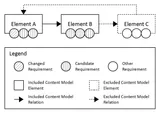
Various drivers, especially increasing market dynamics, force industrial enterprises to evolve their production facilities ever more frequently. Analyzing the impact of changed requirements on the production facilities early in the engineering process would facilitate the estimation of resulting costs and therefore reduce project risk. In industrial practice, requirements specifcations are typically textual lists and only structured by a table of contents; an analysis of the impact of changes within the requirements specifcation is extensive, as no documented information is available about how the requirements and other elements of the requirements specifcation depend on each other.
To identify impacts of changes in a requirements specifcation more effciently, this paper proposes a model-based approach that classifes the elements of a requirements specifcation according to their contents and based on the classifcation preselects automatically candidate elements of the requirements specifcation that are possibly affected by the change. This paper shows the application of the approach on the manufacturing automation systems domain by means of a pick and place unit (PPU) demonstrator. The technical validation demonstrates that in the example of the PPU the impact analysis is more effcient with a content model than on an unstructured list; the effort for impact analysis is reduced further when adapting the content model to the manufacturing automation systems domain.
PublicationMay 11, 2015
Efficient impact analysis of changes in the requirements of manufacturing automation systems
Various drivers, especially increasing market dynamics, force industrial enterprises to evolve their production facilities ever more frequently. Analyzing the impact of changed requirements on the production facilities early in the engineering process would facilitate the estimation of resulting costs and therefore reduce project risk. In industrial practice, requirements specifications are typically textual lists and only structured by a table of contents; an analysis of the impact of changes within the requirements specification is extensive, as no documented information is available about how the requirements and other elements of the requirements specification depend on each other.