PublicationFeb 26, 2025
Next-Generation Design Tools for Intelligent Transportation Systems.
Intelligent Transportation Systems (ITS) promote new transportation paradigms such as connected and autonomous vehicles (CAV), multi-modal and demand-responsive transport systems, and enable the transportation electrification by sustainable operation of electric vehicles. Methods and tools are needed to explore the possible design space for emerging transportation paradigms, which support evaluation of system design alternatives and verification of system properties. In this work, we propose a model-and simulation-based systems engineering framework for capturing design decisions and evaluating control strategies for ITS design. In addition to capturing and evaluating different design decisions, the proposed solution allows users to guide design decisions by systematic comparison and evaluation of system configurations and control strategies.
CourseWinter Term 2025/26
Systems Engineering
Unterlagen für meinen Kurs in Systems Engineering mit MATLAB und Simulink an der Fakultät für Technik und angewandte Naturwissenschaften der FH OÖ.
PublicationNov 14, 2018
Test-driven conceptual design of cyber-physical manufacturing systems
Today, manufacturing system engineering companies face three major trends: First, the systems have to implement more functions and, hence, grow in complexity. Then, besides mechanical engineering discipline the electrical and software engineering disciplines contribute more and more to the functionality of the system and, hence, require increasing efforts. And finally, the integration of the components from the individual engineering disciplines has become a costly task taking up to 25% of the p...»

PublicationSep 11, 2023
Quality assurance of digital twins: an experience report in the automotive industry
Digital twins are becoming increasingly important for the efficient and effective development and operation of cyber-physical systems. However, digital twins are only useful if they reflect the real-world system accurately enough, i.e. their quality is high enough. This claim entails the question, of what the term quality in the context of digital twins means and how it can be measured. In this article, the authors presented their experience with the quality assurance of a digital twin for an assembly line in the automotive industry. Authors explained the preliminary definition of digital twin quality, which authors derived from classical quality models for general software systems. Furthermore, authors described quality issues, which they were able to detect in a digital twin of an assembly line in the automotive industry. Finally, authors concluded how to leverage their experience in different contexts and how to generalize the …
PublicationJun 28, 2016
MaCon: Consistent Cross-Disciplinary Conception of Manufacturing Systems
Conceptual designs of manufacturing systems contain input from all engineering disciplines involved in the life cycle of such systems. For their efficient and consistent conception, information about the elements of a conceptual design and their relationships have to be sufficiently precise but preferably abstract. We employ a cross-disciplinary modeling technique to capture this information together with consistency checking including simulation to accomplish such a challenging task. In this paper, we demonstrate our approach with a tool prototype. Based on an industrial example, we highlight how the features of the tool prototype can effectively support tasks in conceptual design. To illustrate this effectiveness, we visualize the modeling work flow and the results of the consistency checks based on data collected during tool usage.
PublicationFeb 1, 2016
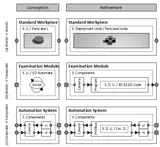
From Conception to Refinement in Mechatronic Systems Engineering
The complexity of mechatronic systems increases constantly due to market requirements. Traditional engineering approaches have troubles coping with the desired functionality. A major problem is the early and continuous integration and coordination of engineering disciplines (i.e. mechanic, electric, and software). To address this situation and to enable a concurrent engineering of participating disciplines, a model-based approach to early conception and subsequent refinement of mechatronic systems is proposed in this paper. This approach allows specifying a high-level mechatronic concept within a single editor and the refinement of this concept by integrating it with established engineering tools. In particular, the paper outlines the technical and methodical integration of discipline-specific tools such that refinement steps can be tested automatically and continuously. The suitability of the approach is shown along selected examples. Finally, the paper finishes with a reflection on the current state and an outlook on future research activities.