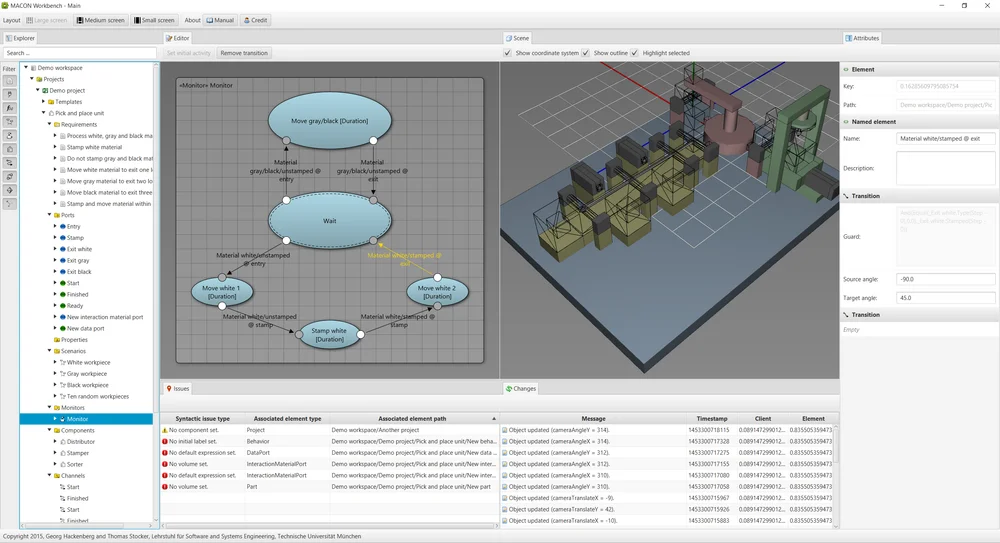
Spatial Systems IDE: Mechatronic 3D Modeling
Integrated Development Environment (IDE) for spatio-temporal mechatronic systems enabling component-based 3D modeling across mechanics and electronics.
Technology Readiness Level
Technology Validated in Lab
Key components and software architecture modules are integrated and tested together in a controlled laboratory environment, establishing that disparate elements work together to achieve baseline performance.
Framework alignment: Standardized 9-level TRL (NASA / EU Horizon Europe).
Core Challenge
Engineering complex mechatronic systems typically suffers from isolated disciplines, sequential design silos, and semantic gaps between 3D mechanical CAD, electrical schematics, and embedded control software.
System Architecture
A unified, model-based integrated development environment (IDE) built in Java and JavaFX/DockFX combining component-based spatio-temporal modeling, multi-physics interface definitions, formal logic constraints, and state-machine simulation.
Key Capabilities
- Component-Based Systems Modeling: Hierarchical decomposition of mechatronic assets into modular structural and behavioral components.
- Interdisciplinary Interface Modeling: Explicit specification and binding of mechanical, electrical, and software interfaces in a common schema.
- State-Machine Behavior Execution: Discrete-event simulation and active monitoring of discrete operational states and transition logics.
- DockFX Modular Workbench: Extensible desktop engineering workbench featuring flexible docking, property sheets, and 3D visualization.
Technology Stack
- Workbench & UI: Java, JavaFX, DockFX
- Systems Modeling & Semantics: Spatio-Temporal Systems, Component-Based Modeling, State-Machine Semantics, Multi-Disciplinary Interfaces
- Simulation & Verification: Discrete-Event Simulation, Logic Constraint Checking, Dynamic State Tracking
Verifiable Outcomes
- Demonstrated integrated model-based engineering principles as part of the TUM IMoMeSA research project (IGF 435 ZN).
- Bridge between mechanical layout, electrical wiring, and software control logic within a single executable environment.
- Open-source research workbench available on GitHub (github.com/ghackenberg/Spatial-Systems-IDE).
Formal Verification & Dissertation Roots
Spatial Systems IDE unifies mechanical 3D geometry, electrical wiring models, and software state-machine control logic within a single DockFX workbench so multidisciplinary design inconsistencies surface during early conceptual modeling rather than late shop-floor commissioning.
The formal modeling semantics, quality taxonomy, and pick-and-place validation experiments originate in the TUM doctoral dissertation Test-driven conceptual design of cyber-physical manufacturing systems and the IMoMeSA project report, shaping our approach to Formal Requirements Engineering.