SimplexViz: Barycentric Knowledge Graph Engine
Open-source TypeScript simplex mesh library for multi-tag knowledge graphs with OKLab color blending, SAT packing, and 1:4 drill-down.
Technology Readiness Level
System Prototype Demonstration in Operational Environment
The prototype is deployed and evaluated in the actual operational environment under real-world conditions, demonstrating end-to-end system performance and addressing operational hurdles.
Framework alignment: Standardized 9-level TRL (NASA / EU Horizon Europe).
Core Challenge
Traditional force-directed graph layouts collapse densely connected, multi-tag knowledge items into tangled hairballs where overlapping labels and unpredictable spring equilibria obscure semantic structure.
System Architecture
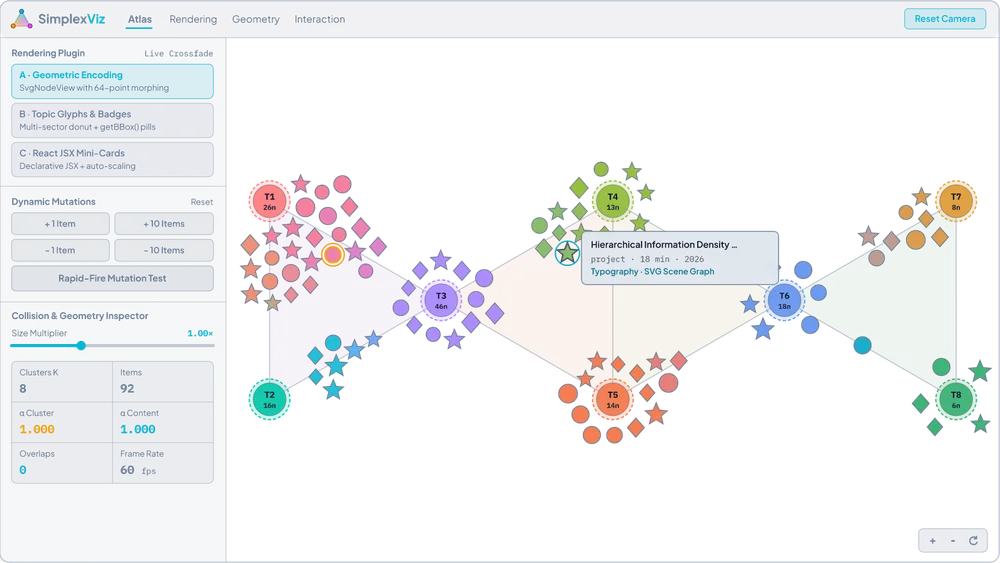
A deterministic, framework-agnostic TypeScript geometry kernel and SVG rendering engine (@simplex-viz/svg) that anchors topic clusters to a 60-degree equilateral simplex triangulation lattice, projects items via barycentric tag weights, and guarantees 0.0 px node overlap through Position-Based Dynamics and SAT hull dispersion.
Key Capabilities
- 60° Simplex Triangulation: Anchors canonical topic clusters to an adaptive equilateral triangular lattice via Jaccard annealing, eliminating force-directed hairballs.
- Zero-Overlap PBD & SAT: Resolves node collisions to 0.0 px using Position-Based Dynamics and Separating Axis Theorem (SAT) hull checks inside each simplex.
- OKLab Perceptual Mixing: Computes edge-contrast cluster hues and smoothly blends multi-tag item colors in perceptual OKLab space for dark and light themes.
- Conformal 1:4 Drill-Down: Supports both continuous free-camera pan/zoom and discrete hierarchical 1:4 triangle subdivision for inspecting dense subspaces.
Technology Stack
- Core Engine & Geometry: TypeScript, Barycentric Coordinate Projection, Position-Based Dynamics (PBD), Separating Axis Theorem (SAT)
- Rendering & Color: Reconciled SVG Scene Graph, @simplex-viz/svg, OKLab Perceptual Color Space
- Demo & Ecosystem: React, Vite, Open Source
Verifiable Outcomes
- Published as a modular, zero-dependency TypeScript SVG engine (@simplex-viz/svg) powering live interactive knowledge graph exploration.
- Achieves deterministic 0.0 px node overlap and smooth 60 fps spring transitions across dynamic item mutations.
- Integrated directly into this portfolio's interactive knowledge-graph workbench at /visualizations/simplex-viz/.
1. The Challenge
Multi-tag knowledge bases, research portfolios, and software catalogs rarely fit into strict tree hierarchies: a single article, project, or component frequently belongs to three or more overlapping domains. When rendered with classical force-directed physics, high-degree topic hubs pull shared items toward the center, producing dense visual “hairballs” with severe label occlusion and non-deterministic layouts that shift unpredictably on every reload or data mutation.
SimplexViz was engineered to solve this legibility bottleneck by replacing global spring-repulsion heuristics with a deterministic, geometry-first spatial model that preserves multi-tag membership without sacrificing zero-overlap clarity.
2. Architecture & Solution
SimplexViz decouples spatial computation from DOM rendering inside a clean, layered pipeline:
- Cluster Derivation & Adaptive Simplex Lattice: Canonical topic clusters are derived from tag co-occurrence (Jaccard annealing) and anchored to the vertices of an aspect-aligned 60° equilateral triangular mesh (
createAdaptiveHexMeshStrategy). - Barycentric Projection & Zero-Overlap Dispersion: Every content item is projected onto the convex hull of its active topic anchors using normalized tag weights. Iterative Position-Based Dynamics (PBD) paired with Separating Axis Theorem (SAT) hull checks then disperses neighboring items to guarantee
0.0 pxoverlap. - OKLab Perceptual Color Mixing: Cluster vertices receive edge-contrasting hues, and multi-tag items blend their assigned cluster colors inside the perceptual OKLab color space, maintaining uniform contrast across both light and dark themes.
- Pluggable Rendering & Camera Strategies: The
@simplex-viz/svgcontroller reconciles a crisp SVG scene graph with60 fpsspring transitions across three visual presets—geometric(rank-coded shapes),glyphs(multi-sector donuts), andbadges(auto-sized cards)—while supporting both continuous free-camera navigation (createFreeCameraZoomStrategy) and discrete hierarchical1:4triangle subdivision (createBarycentricZoomStrategy).
Explore the live interactive integration on this site in the SimplexViz Visualization Workbench.
3. Tech Stack & Libraries
The implementation separates pure geometric layout computation from DOM rendering and framework-specific UI chrome across three layers:
- Core Geometry & SVG Engine: Strict TypeScript (
@simplex-viz/svg), reconciled SVG DOM scene graph, custom PBD/SAT collision solver, and OKLab color math. - Interactive Demo & Diagnostics: React + Vite showcase application featuring live rendering-plugin crossfades, dynamic item mutation stress tests (
+1/+10items), and a real-time collision/FPS inspector. - Host Integration: Embedded directly in this Astro portfolio via a dedicated engine adapter (
src/content/visualizations/simplex-viz/engine.ts) with touch direction-locking and drag-vs-click disambiguation.
4. Key Takeaways & Impact
SimplexViz demonstrates that deterministic simplex geometry can replace stochastic force-directed layouts for multi-tag knowledge exploration:
- Deterministic Clarity: Replacing chaotic force-directed physics with barycentric simplex projection makes multi-tag relationships immediately readable at a glance.
- Guaranteed
0.0 pxOverlap: Combining barycentric equilibrium with SAT-backed PBD keeps dense clusters legible even under dynamic item additions or size-multiplier scaling. - Production Integration: Deployed both as a standalone interactive explorer (hackenberg.tech/simplex-viz/) and as an integrated engine in the SimplexViz Visualization Workbench.